- Accueil
- Association
- Album
- Boutique
- Renault Agriculture
- Pièces
- Privilège
- Forum
-


-
 connectés :8

Site développé par Jacques & Jérérmy Gouet
connectés :8
Site développé par Jacques & Jérérmy Gouet

|
© Tous droits réservés Jacques Gouet & ATR 1993-2024
1975 - 1985
Extracts
taken from the CD-Rom "Amicale du Tracteur Renault" (1999 - Jacques
Gouet)
and extracts from the "Encyclopédie du Tracteur Renault"
Three volumes (1919-1970) - (1971-2000) - (2000-2005) Editions ETAI
(Reproduced on this site with permission of ETAI)
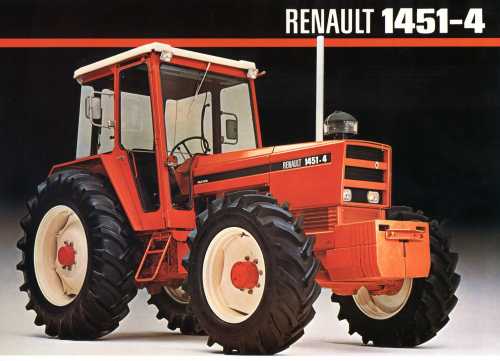
| The trend towards increased horsepowers continued, a 145HP tractor was urgently needed for commercial reasons. In 1975 the 1451-4 was introduced. As Renault had no transmission for a tractor of this size a ZF transmission was used together with a ZF front axle. |
|
The oil crisis brought attention to the fuel consumption, one of the strong points of the MWM engines. This enabled Renault to once again exceed a market share of 15% (production of 67 tractors per day) on a falling market and move into first position in terms of numbers of registrations in France.
This year also saw important changes in safety legislation, particularly in relation to the introduction of safety frames and new OECD tests for the cabs.
Renault, always anxious to improve the comfort of the customer, made use of these changes to improve their cab interiors.
Renault, as a tractor manufacturer, needed to put in place agreements with machinery manufacturers. It was with Riviere Casalis that as supplier that Renault was able to offer complete range of balers bringing to an end the distribution of Carraro machinery.
In
|
|
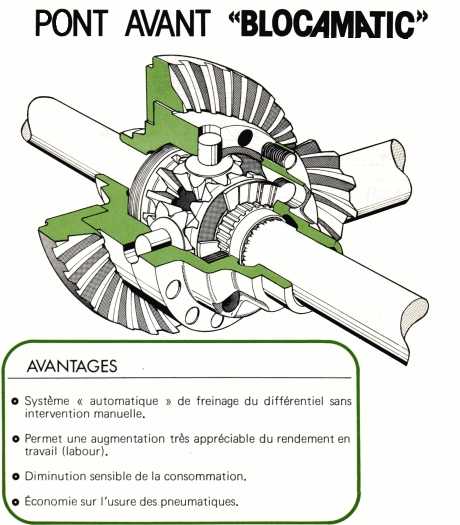
The increasing popularity
of 4 wheel drive caused the research & development dept. to further
improve the front axle. Renault already had one of the best front-rear
weight distributions on the market and now Renault fitted the Blocamatic
system to the front axles. |
|
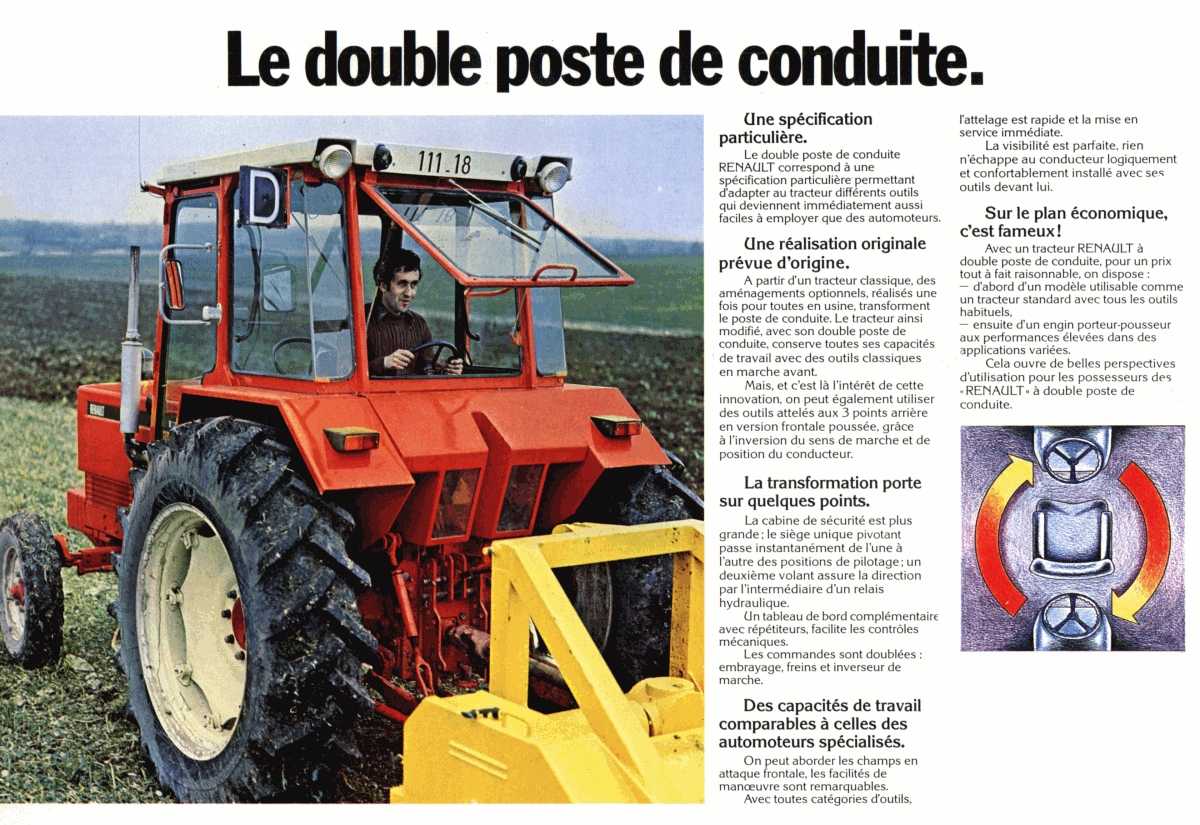
Also during this year
the reverse drive system was developed. This allowed the tractors to work
more efficiently when operation forage harvesters, snow ploughs and mowers
etc. |
|
Renault
also held a large demonstration near Montelimar to show its public works models
to industrial and local authority customers.
|
|
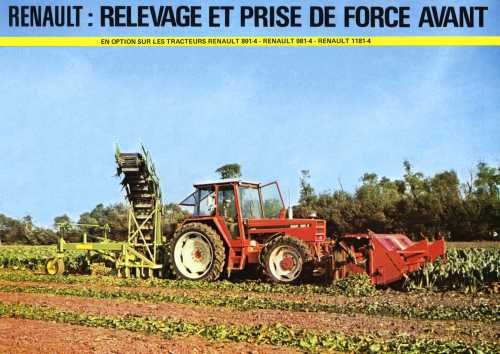
You should not put the plough
infront of the horses says the proverb ; In fact this is exactly what
Renault did in 1977 with the introduction of the front linkage and power take
off which further increased the output of the tractors.
|
On the 10 October 1977 the agricultural machinery and forestry equipment division was created. This included CEMET the forestry machinery specialist. Renault further increased its control over Riviere Casalis in 1978 by taking a majority holding in the group. The Riviere Casalis range was included in the Renault range. Mr. Abonnat, ex industrial director of Renault took control of the division.
|
The tractor range
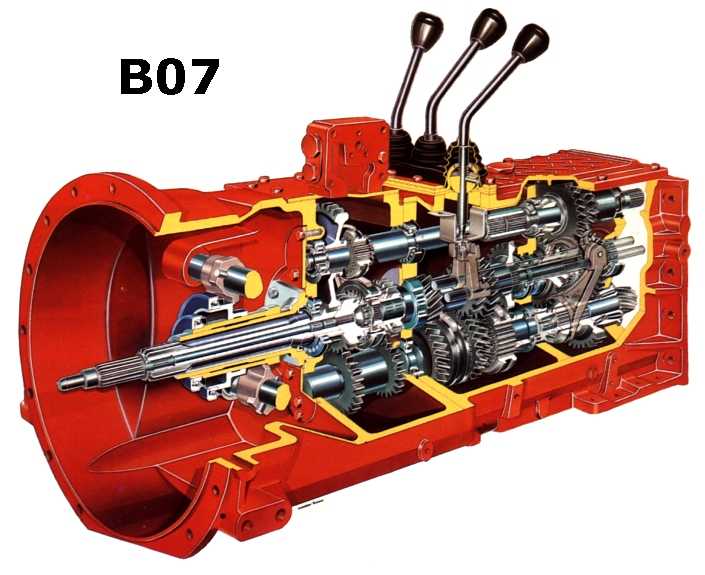
continued to evolve in 1979 with the introduction of the B07 gearbox with
mechanical synchromesh reverser on the medium range. |
|
At the same time the
reduction of noise levels became important, cab interiors gradually improved
with the introduction of heating, ventilation and radios.
|
|
Renault
once again finished 1978 in
first place in registrations in |
|
|
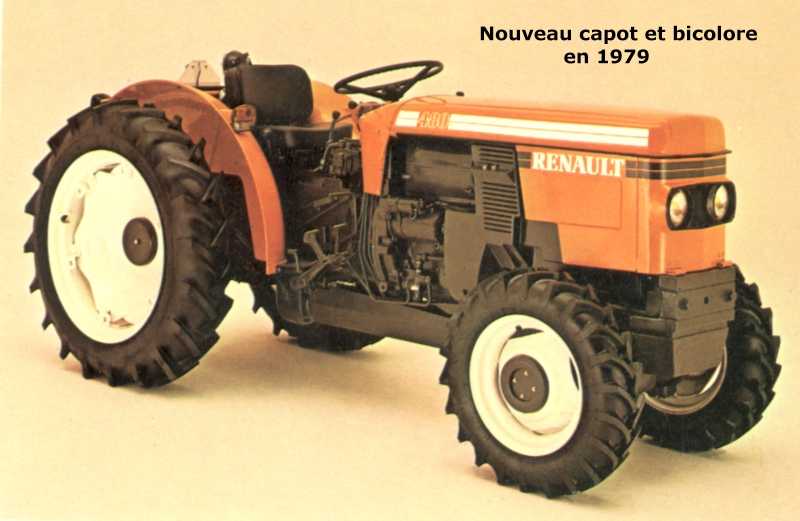
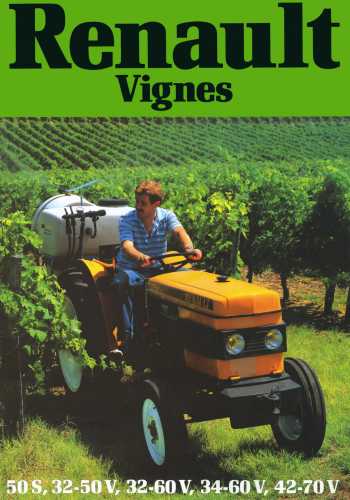
At the end of 1979 and
beginning of 1980 the vinyard and orchard range were facelifted and had two
colour paintwork.
In 1980 the Renault group decided to identiy each division with its own logo.
Thusthe Renault Agriculture logo became the one you see on the screen with green
to represent agriculture.
|
As the 4 wheel drive market
was becoming more important Renault invested in production facilities to produce
their own
front axles for the whole range.
|
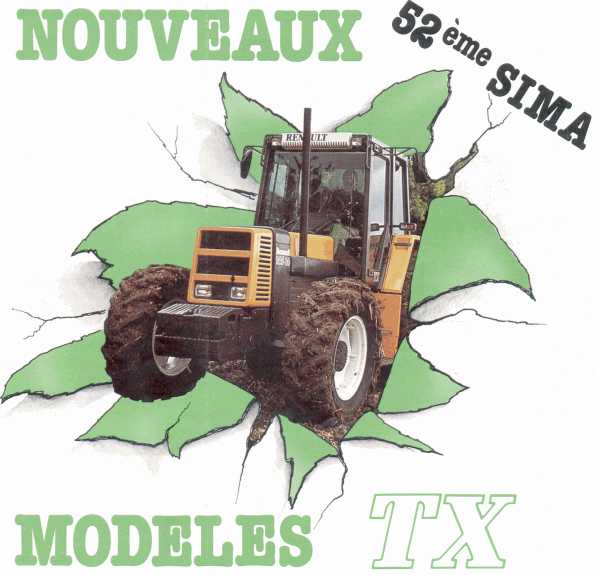
1981 was a renaissance year for Renault Agriculture -
introduction
of the TX range ! -
introduction
of the S range -
introduction
of a new 2 colour paintwork An
unequaled press campaign and network presentation accompanied these models. In a depressed market in 1981 Renault created a sensation at the SIMA show.
The TX range obviously
offered many technological and ergonomic anvances and was awarded the « Formes
and Industries » certificate from the French Industrial Design Institiute.
|
|
Among the many new features were :
-
an
adjustable and pivoting seat
-
an
adjustable steering wheel
-
a
transmission with a mechanical synchromesh reverser
-
a
front linkage and power take off
-
a
tilting cab to improve ease of access to the main components
-
and
to improve driver comfort air conditioning.
The
sucess of this new range was not long coming. In 1981 Renault gained 19.01%
penetration in
The range was enlarged in 1982 with some lower power tractors such as 103-12 ,103-14, 95-12 and 95-14 TX.
In September 1982 Renault launched the TS range in response to economic conditions in the agricultural world.
The
TS was a reduced specification version of the TX with only one door.
|
|
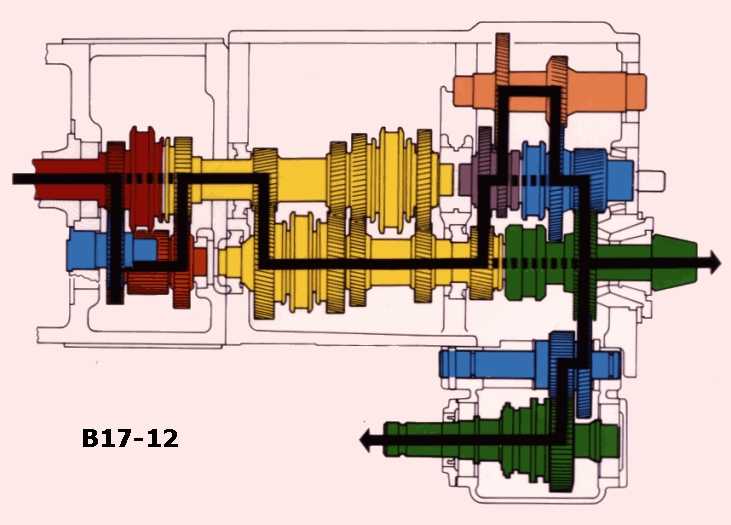
The TS range reached down to 75-12 and 75-14 TS which was also fitted with the new B17 transmission. |
Fuel costs continued at a high level and in 1983 Renaul,t in colaboration with CEMAGREF, developed the
ECOCONTROL driver information system. This simple visual display required the driver to operate the tractor in such a way that the two needles on the display remained crossed in the green zone to ensure fuel efficient operation.
This concept was awarded a gold medal at SIMA in 1983.
On the 24 October 1984 Mr. Denis Berger was replaced by Mr. Gilbert Guez as managing director of Renault Agriculture.
|
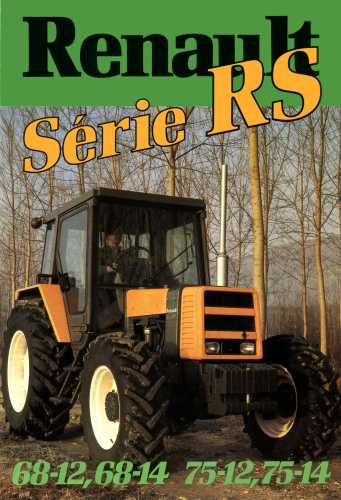
The RS range was introduced in 1984, the main difference was in the
superstructure and adaptable cab. The idea was to develop a configurable
cabin based around a safety frame. This range had little sucess and was
only sold for 3 years. |
|
Translated with Andrew Knowles |